

Health Insurance Premiums Could Rise About 15% in 2027. Here’s What to Do Before Open Enrollment.
Thyrza De Oliveira
August 3, 2026
2027 premiums
Insurers proposed a median increase of about 15% for 2027. Rates aren’t final everywhere, and there’s still time to get ahead of it.
The short version
- Insurers proposed a median increase of about 15% for 2027 (KFF, August 3, 2026). These are proposed rates. States review them, and final rates can be higher or lower.
- It’s the second double-digit increase in a row. The median final increase for 2026 was 20%.
- The extra Marketplace subsidies expired December 31, 2025. As of October 12, 2026, Congress has not brought them back.
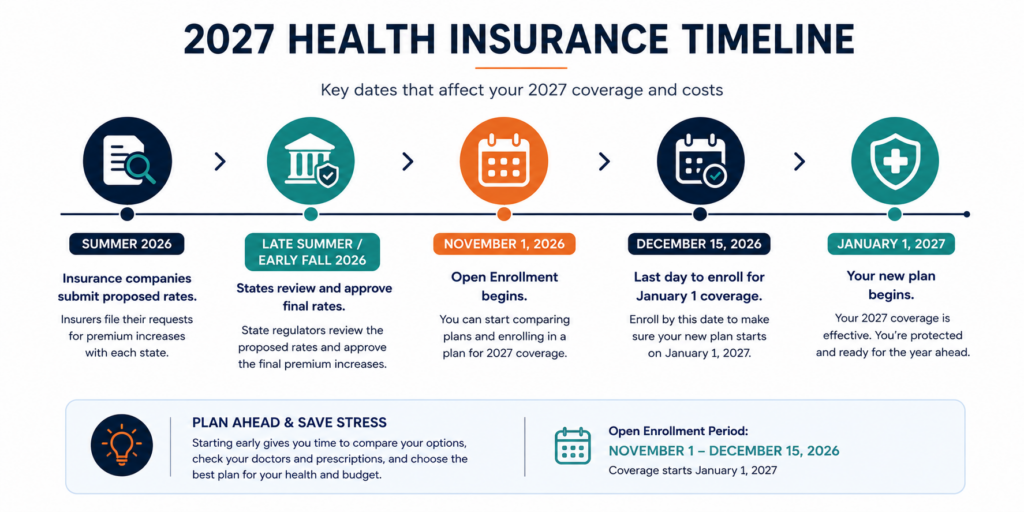
- Open Enrollment for 2027 runs November 1, 2026 to January 15, 2027 on HealthCare.gov. Pick a plan by December 15 if you want it to start January 1.
- If you earn too much to qualify for a Marketplace subsidy, you pay the whole increase. Run your numbers before you renew.
Worried about what your health insurance might cost in 2027?
I’m a licensed agent in 31 states and I offer private health plans. Bring me your 2027 Marketplace number and I’ll put a private quote next to it. If the Marketplace is the better fit, I’ll tell you and point you to someone who enrolls Marketplace plans. Get a quote, book a 30-minute call, or text me at 954-501-5554.
If you’ve seen headlines about health insurance premiums increasing for 2027, you might be wondering whether your monthly payment is about to skyrocket.
The short answer? Not necessarily.
Insurance companies filed their proposed 2027 rates this summer, and KFF found a median proposed increase of about 15% across all 50 states and DC. Those are proposed rates. State regulators review them, and many states have finalized since, so your own number could be higher or lower. The direction is clear, though: costs are going up again. The good news is there’s still time to prepare before Open Enrollment starts November 1.
Why Are Premiums Increasing?
Insurance companies file proposed premiums every year. Regulators review them. Some increases are approved as requested. Others are reduced. The important takeaway isn’t the exact percentage. It’s that premiums are expected to rise again for 2027.
- Care costs more. Insurers point to higher prices for health services, general inflation and labor shortages.
- A sicker risk pool. Insurers also point to the enhanced subsidies expiring at the end of 2025. When healthy people drop coverage, the people who stay use more care on average, and that cost is shared by everyone left.
Source: KFF, How much and why ACA Marketplace premiums are going up in 2027 (August 3, 2026). None of this reverses on its own. It’s the second year in a row of double-digit increases, not a one-year spike.
Medical Costs
Labor and inflation
Higher Claims
Marketplace Changes
Long-Term Trend
Did the extra ACA subsidies come back for 2027?
Not as of October 12, 2026. The enhanced premium tax credits that lowered Marketplace prices from 2021 through 2025 expired on December 31, 2025. In December 2025 the Senate voted on two bills and neither got the 60 votes it needed to move forward. On January 8, 2026 the House passed a three-year extension, 230 to 196. As of the date above, nothing has been signed into law.
Source: AHA News, January 9, 2026.
Who Could Feel These Increases the Most?
If you get a subsidy, it usually grows when the benchmark plan in your area gets more expensive, so part of the increase is covered for you. If you pay full price, all of it lands on you:
- People who earn too much to qualify for a Marketplace subsidy. With the enhanced subsidies gone, help stops at 400% of the federal poverty level (HealthCare.gov). Above that, you pay the whole premium yourself. If your income is close to that line, read how 2026 subsidies work before you assume anything.
- Self-employed and 1099 workers whose income moves around. A Marketplace subsidy is based on your guess of this year’s income, so a big year can mean paying some of it back at tax time. If that’s you, start with health insurance for the self-employed.
- People whose insurance company is leaving. Cigna is leaving the Marketplace in all 11 states where it sells plans for 2027 (what Cigna members need to know), and other insurers are leaving some areas too (KFF tracks every change). If that’s you, you’re not choosing between your plan and a cheaper one. You’re choosing between strangers.
See what a private plan costs you: 3 fields, 30 seconds.
People without subsidies
Self-employed
People whose carrier is leaving
What Can You Do Before Open Enrollment?
- Know the real dates. Open Enrollment for 2027 runs November 1, 2026 to January 15, 2027 on HealthCare.gov. Pick a plan by December 15 if you want it to start January 1. Enroll December 16 to January 15 and it starts February 1. If you’ve seen December 15 called the last day, that’s the last day for a January 1 start, not the end of Open Enrollment. States that run their own Marketplace can have different dates, so check yours (HealthCare.gov dates and deadlines).
- Get a private quote while you have time. Private plans are priced on health history, not income, and they’re medically underwritten, so not everyone qualifies. If you’re healthy and earn too much to qualify for a Marketplace subsidy, it may make sense to set a private quote next to your renewal. Here’s how a private PPO compares.
- If you’re staying on the Marketplace, still shop. The 15% is a median. Your own plan’s increase could be higher or lower, and switching to another Marketplace plan during Open Enrollment doesn’t cost anything extra. Just know a new plan usually starts a new deductible.
- Know your state’s picture. Filings vary a lot by state. Check your state’s private health insurance page for what’s available where you live.
What should I do when my renewal letter arrives?
Open it, find four numbers, and add up the whole year before you decide. Here’s the order I’d do it in:
- Find the new 2027 premium. Multiply it by twelve.
- Find the other three numbers: deductible, max out of pocket and network. Here’s how the four numbers work and what a full year really costs.
- Add up what you actually paid in 2026, premium plus bills. That’s your baseline.
- Check every doctor and prescription you care about against any plan you’re considering. Here’s how to check if a doctor is in network.
- Check whether you qualify for a subsidy for 2027. If you do, shop the Marketplace. If you don’t, get a private quote to compare.
- Don’t let the Marketplace auto-renew you into a plan you never looked at.
- Self-employed? Ask your CPA about the self-employed health insurance deduction.
It’s about an hour of work.
What I’d do this month
A proposed rate is not a final rate, but two years of double-digit filings is a trend, not a headline.
Nobody likes paying more for health insurance. You can’t control the increase. You can control how ready you are when the letter shows up.
Comparing your options before Open Enrollment gives you time to understand your choices, review provider networks, estimate your costs, and avoid making rushed decisions. The earlier you start, the more confident you’ll feel when it’s time to enroll.
Not sure what the increase means for you?
Here’s what I’ll do on a call:
✔ Help you add up what 2027 could cost you
✔ Put a private quote next to your Marketplace renewal
✔ Check your doctors
✔ Check your prescriptions
✔ Answer your questions
If the Marketplace is the better fit, I’ll tell you and point you to someone who enrolls Marketplace plans. Request a quote or book a call with me, or text me at 954-501-5554.
Frequently Asked Questions
If you’re self-employed or earn too much to qualify for a Marketplace subsidy, a private PPO is one alternative worth comparing before you renew. It isn’t a fit for everyone, so compare both.
About the author. Thyrza Oliveira is a licensed health insurance agent (NPN 21702538) based in South Florida and licensed in 31 states. She offers private PPO plans and refers Marketplace enrollment to a Marketplace-enrolling agent when that’s the better fit. About Thyrza · Contact
Published: August 3, 2026 · Updated: October 12, 2026 · Reviewed: October 12, 2026 (rates, subsidy status and Open Enrollment dates rechecked)
Sources: KFF, How much and why ACA Marketplace premiums are going up in 2027 (Aug 3, 2026) · KFF, tracking insurer participation changes in 2027 · HealthCare.gov, dates and deadlines · AHA News, House passes bill extending enhanced premium tax credits (Jan 9, 2026).
Guide: how to replace or upgrade your health plan
Losing coverage or going out on your own? Enter your email and I’ll send you my plain-English guide to private PPO coverage.
Prefer to just talk it through? Reach me directly — I’m a real licensed agent, and I reply fast.
Rather not talk yet? Get my quote online →
Have questions? Let’s talk.
I’m a real licensed agent. Not a call center, not a 600-call-a-day vendor. Reach out and I’ll get back to you within one business day, usually faster.
Prefer to send details? Use the quote form on this page.
Thyrza Mariano Amorim de Oliveira is a licensed health insurance agent. NPN: 21702538. Licensed across multiple states; verify any agent on the National Insurance Producer Registry.

Hi, I’m Thyrza
Founder of Find Coverage LLC, I help clients find private PPO plans that actually fit their lifestyle