




Health Insurance Premiums Could Jump Another 14% in 2027. Here’s How to Get Ahead of It.
Thyrza De Oliveira
August 3, 2026
2027 premiums
Insurers requested a median ~14% increase for 2027 — but rates aren’t final, and there are moves you can make now to get ahead of it.
The short version
- Insurers filed proposed 2027 rates with a median requested increase of about 14% — still subject to state review before they’re final.
- Your exact payment isn’t set yet, but the trend of rising costs is clear.
- The move is to prepare before Open Enrollment, not react after.
- Comparing marketplace and private options ahead of renewal can offset a big increase.
- The headline number matters less than what your plan and your situation actually do at renewal.
Worried about what your health insurance might cost in 2027?
I’m licensed in 31 states and help individuals, families, and self-employed professionals compare Marketplace and private health insurance options at no cost. Get your free quote, book a 30-minute call, or call/text 954-501-5554.
If you’ve seen headlines about health insurance premiums increasing for 2027, you might be wondering whether your monthly payment is about to skyrocket.
The short answer? Not necessarily.
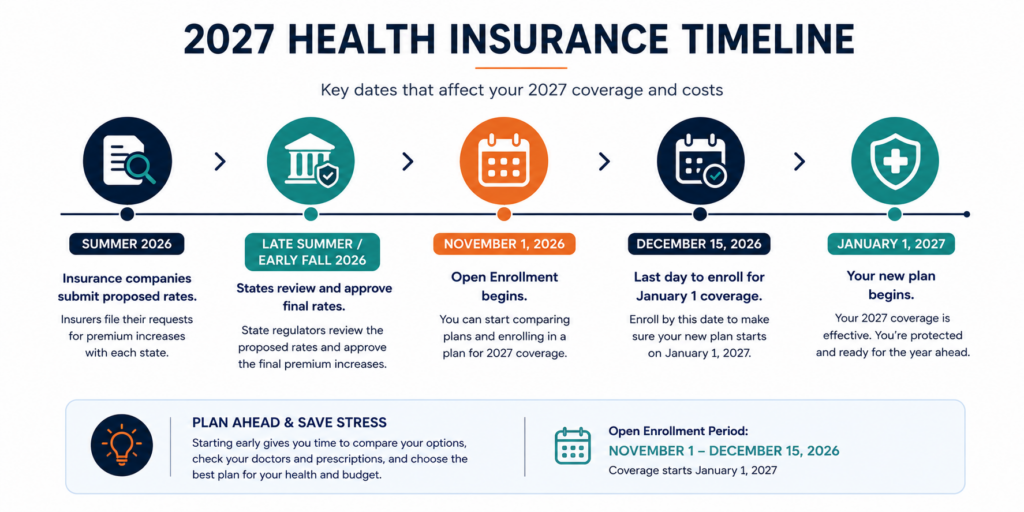
Insurance companies have submitted their proposed rates, and the median requested increase is around 14%. However, those rates are still subject to state review before becoming final. Even so, the overall trend is clear: health insurance costs continue to rise. The good news is that there are steps you can take now to prepare before Open Enrollment begins.
Why Are Premiums Increasing?
Insurance companies file proposed premiums every year. Regulators review them. Some increases are approved as requested. Others are reduced. The important takeaway isn’t the exact percentage. It’s that premiums are expected to rise again for 2027.
- Medical costs themselves are up about 10% — hospital care, physician wages, and prescription drugs, especially GLP-1 medications.
- The risk pool got sicker. When the enhanced subsidies expired at the end of 2025, many healthy people dropped coverage. The people who stayed use more care, and everyone remaining shares that cost — analysts estimate this alone adds roughly 4 percentage points in both 2026 and 2027.
- New federal rules (the Marketplace Integrity and Affordability Rule) change enrollment and verification requirements, and insurers price in the uncertainty.
None of these reverse on their own. This is the second straight year of steep increases, not a one-year spike.
Medical Costs
Prescription Drugs
Higher Claims
Marketplace Changes
Long-Term Trend
Who Could Feel These Increases the Most?
If you receive a subsidy, subsidies absorb part of the increase. The full 14% lands on people who pay sticker price:
- Anyone over the subsidy cliff — earn a dollar past 400% of the federal poverty level and you pay the entire premium yourself. If your income sits near the line, read how the 2026 subsidy cliff works before you assume anything.
- Self-employed and 1099 workers with variable income — the marketplace’s estimate-and-reconcile model punishes income swings; a big year can turn into a subsidy repayment bill at tax time.
- People whose carrier is also leaving. Cigna is exiting the exchanges in 11 states for 2027 (what Cigna members need to know), and several regional carriers are following. If that’s you, you’re not choosing between your plan and a cheaper plan — you’re choosing between strangers.
See what a private plan costs you — 3 fields, 30 seconds.
People without subsidies
Self-employed
People whose carrier is leaving
What Can You Do Before Open Enrollment?
- Don’t wait for the renewal letter. Final rates get approved in late summer and early fall. By the time your letter arrives, Open Enrollment (November 1 – December 15) is already moving.
- Run the marketplace-vs-private comparison while you have time. Private plans are health-based, not income-based — for healthy families over the subsidy cliff, they’re often meaningfully cheaper, and you can enroll year-round. Start with the 5-question checklist on whether to leave the marketplace.
- If you’re staying on the marketplace, still shop. The 14% is a median — your specific plan’s increase could be higher, and switching plans inside the marketplace is free.
- Know your state’s picture. Filings vary a lot by state. Check your state’s private health insurance page for what’s available where you live.
The bottom line
A proposed rate is not a final rate, but two years of double-digit filings is a trend, not a headline.
No one likes paying more for health insurance. While none of us can control premium increases, we can control how prepared we are.
Comparing your options before Open Enrollment gives you time to understand your choices, review provider networks, estimate your costs, and avoid making rushed decisions. The earlier you start, the more confident you’ll feel when it’s time to enroll
Not sure how these proposed premium increases could affect you?
I help individuals, families, and self-employed professionals compare Marketplace and private health insurance options before Open Enrollment.
During your free consultation we’ll:
✔ Estimate your 2027 costs
✔ Compare Marketplace and private plans
✔ Check your doctors
✔ Review prescriptions
✔ Answer your questions
Schedule your free consultation. Request your free quote or book a call with me — or call/text 954-501-5554.
Frequently Asked Questions
If you’re self-employed or don’t qualify for subsidies, a private PPO is one alternative worth comparing to the ACA Marketplace before you renew — it isn’t a fit for everyone, so compare both.
📋 Free guide: How to replace or upgrade your health plan
Losing coverage or going out on your own? Enter your email and I’ll send you my plain-English guide to private PPO coverage — no subsidy games, no sales pressure.
Prefer to just talk it through? Reach me directly — I’m a real licensed agent, and I reply fast.
Rather not talk yet? Get a free quote online →
Have questions? Let’s talk.
I’m a real licensed agent. Not a call center, not a 600-call-a-day vendor. Reach out and I’ll get back to you within one business day, usually faster.
Prefer to send details? Use the quote form on this page.
Thyrza Mariano Amorim de Oliveira is a licensed health insurance agent. NPN: 21702538. Licensed across multiple states; verify any agent on the National Insurance Producer Registry.

Hi, I’m Thyrza
Founder of Find Coverage LLC, I help clients find private PPO plans that actually fit their lifestyle